
Virse equips soft-goods designers, luggage brands, and outdoor gear teams with an AI backpack designer on its Creative Canvas to generate coordinated front, profile, and rear exterior pack renders across fabrics and colorways.
United States, 10th Nov 2026 – Virse equips bag and luggage brands, freelance soft-goods designers, and outdoor gear merchandising teams with a dedicated AI backpack designer inside its node-based Creative Canvas. Built specifically for visual exterior concept development, the workflow lets designers generate multi-angle bag renders, test fabric and hardware combinations, and compare seasonal colorways side by side before committing to physical sample sewing.
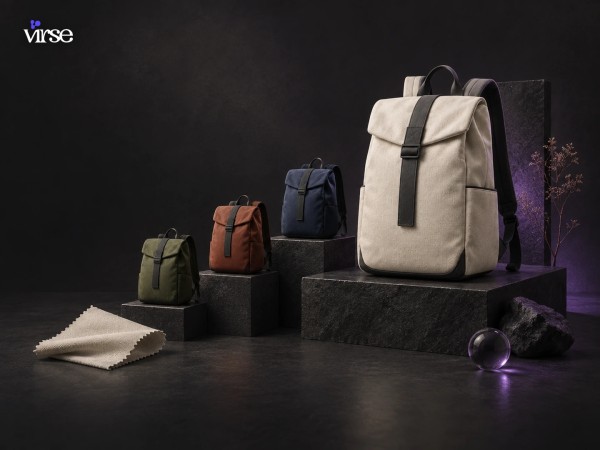
Developing a new commuter daypack, alpine rucksack, or collegiate bookbag requires balancing silhouette proportion, pocket layout, and material contrast across several viewing angles. A front-panel sketch alone rarely tells the whole story. Merchandisers and retail buyers want to see how the side water-bottle gussets sit against the main compartment, how the contoured shoulder straps attach to the back panel, and whether a high-contrast zipper pull works across three different seasonal colorways. In traditional soft-goods workflows, rendering realistic front, three-quarter, and rear views in five fabric combinations takes days of manual digital painting or 3D cloth simulation before a sample room ever cuts a yard of nylon.
Virse shortens that early concept review cycle by placing its backpack design generator directly on an infinite visual canvas. Rather than producing a single static front view that forgets the bag’s structure on the next prompt, the workspace helps designers explore cohesive multi-angle exterior concepts while keeping their reference sketches, fabric swatches, and brand logos linked as visible nodes.
Reviewing colorways, fabrics, and multi-angle silhouettes side by side
When searching for terms like ai backpack or ai backpack design, commercial gear designers are not looking for novelty gadgets; they need a practical visual tool that understands soft-goods construction language. Virse’s workflow is structured around the actual decisions a bag designer makes during line planning.
From a single concept node, designers can generate coordinated front, three-quarter profile, and back-panel strap views so the team can evaluate depth, gusset taper, and carry geometry together. Once a silhouette is approved, the user can branch that node across the canvas to compare heritage olive waxed canvas with tan leather lash tabs against matte black 500D Cordura, technical ripstop nylon, or high-visibility trail color blocks. Designers can also attach an existing brand mark or woven label reference directly to the canvas node to preview how their logo sits on the top stash pocket, front daisy chain, or shoulder strap webbing.
Because Virse unites 50+ AI models with its in-house aesthetic model and Aesthetic Memory, a soft-goods team can maintain consistent studio lighting and material realism across an entire 12-piece carry collection. If a creative director wants to swap a roll-top closure for a clam-shell zip or test a contrasting Hypalon base panel, they can instruct Virse Composer in plain language right on the canvas.
“Soft-goods teams need to see how pocket proportions, fabric textures, and colorway blocks hold up from more than one angle before they brief a sample maker,” said a spokesperson for Virse. “Virse gives bag designers a connected canvas where they can iterate on silhouettes, attach their own brand emblems, and review an entire seasonal colorway matrix on one screen.”
Connecting backpack concepts with line art, surface prints, and embroidered patches
In an accessory or outdoor apparel studio, a custom backpack design project connects directly to textile print development, technical line drawings, and custom trim badges. Virse’s node-based Creative Canvas allows designers to link their bag renders with companion tools across the platform.
When a designer starts from a taped paper mockup or a vintage archive pack, they can pass a smartphone snapshot through the line art extractor to isolate clean seam lines and pocket proportions for early design critiques. For campus daypacks, resort totes, or kids’ back-to-school lines that feature patterned panels, textile designers can pull a flat repeatable motif from a swatch photo using the fabric pattern design workflow and test that print across the backpack’s front pocket and main body panels.
Streetwear and outdoor packs frequently feature sewn-on woven labels, chenille crests, or hook-and-loop morale badges. Teams can develop those custom badges in the embroidered patch design tool and branch them directly onto their backpack concept board. When combining rendered bag concepts with studio photography for a pre-book sales deck, retouchers can also apply image color transfer on the canvas from a master campaign photo so every visual shares uniform contrast and color warmth.
All approved bag renders, colorway matrices, and reusable Smart Nodes can be saved into Virse’s shared Asset Folders, keeping industrial designers, graphic artists, and product line managers aligned inside one workspace.
Four steps to run the AI backpack design generator on Virse
Designers and product developers follow a four-step sequence on the canvas to build and review bag concepts. They start by specifying whether the concept is a 15-inch urban commuter pack, a 30-liter alpine hiking pack, a camera bag, or a campus daypack. Second, they detail the shell fabric (ballistic nylon, waxed duck canvas, recycled ripstop, or leather), hardware finishes, pocket layout, and color palette. Third, they optionally attach a brand emblem or silhouette sketch on the canvas before running the ai backpack design generator to compare front, side, and rear perspectives.
Virse maintains clear boundaries regarding what the tool produces. The AI Backpack Design Generator outputs 2D multi-angle exterior renders and colorway previews for concept ideation, line reviews, and client presentations. It does not generate flat sewing cutting patterns, seam allowance markers, hardware bills of materials (BOMs), or factory-ready tech packs. Once a visual concept is selected, soft-goods developers use the approved renders as visual references when drafting factory specifications.
Soft-goods developers, carry brands, and industrial design students can explore custom backpack concepts on virse.ai starting with 200 complimentary compute credits. Teams managing seasonal carry collections can scale onto Pro, Max, or Business workspaces supporting up to 50 studio collaborators.
About Virse
Founded in Dover, Delaware, by AI researchers and industrial designers with more than 100 international design awards, Virse is a human-led AI creative system built for product, apparel, and brand teams. The workspace connects 50+ specialized image models, Virse Composer, and Aesthetic Memory inside a single node-based canvas. From initial silhouette sketches to multi-angle colorway boards and seasonal lookbooks, Virse keeps creative direction unified across every stage of visual development.
Media Contact
Organization: Virse
Contact Person: Virse Media Relations
Website: https://www.virse.ai/
Email: Send Email
Country: United States
Release id: 50594
View source version on King Newswire:
Virse Enables Multi Angle Custom Backpack Design and Colorway Reviews on Canvas
Disclaimer: The views, suggestions, and opinions expressed here are the sole responsibility of the experts. No Times World USA journalist was involved in the writing and production of this article.
